
Table of Contents
Introduction
Digital marketing gives businesses many ways to reach customers through search engines, social media, websites, email, and paid advertising. However, simply running campaigns is not enough. Additionally, companies must determine whether their marketing initiatives are yielding significant outcomes. This is where it becomes crucial to measure and improve the performance of digital marketing.
Marketing performance measurement helps businesses understand which campaigns generate traffic, leads, conversions, and revenue. Without proper tracking, companies may continue spending money on activities that produce little value.
Measuring Digital Marketing Performance allows marketers to make decisions based on real data instead of assumptions. By monitoring the right metrics, businesses can identify successful strategies, discover weak areas, and continuously improve their marketing results.
A strong measurement process includes clear goals, relevant key performance indicators, analytics tools, performance reports, testing, and ongoing optimization.
What Is Digital Marketing Performance?
Digital marketing performance refers to how effectively marketing activities achieve specific business objectives.
A company may use SEO, Google Ads, social media marketing, email campaigns, content marketing, or Meta Ads. Each channel generates different types of data.
For example, an SEO campaign may focus on organic traffic and keyword visibility, while a Google Ads campaign may focus on conversions, cost per click, and return on ad spend.
Measuring Digital Marketing Performance establishes a connection between these marketing campaigns and real business outcomes.
Performance can be evaluated through areas such as:
- Website traffic
- Search visibility
- Leads generated
- Conversion rate
- Customer acquisition cost
- Social media engagement
- Advertising performance
- Sales
- Revenue
- Marketing ROI
Tracking these areas helps businesses understand whether their marketing strategy is moving in the right direction.
Why Measuring Digital Marketing Performance Is Important
Businesses invest time, money, and resources into digital marketing. Without measurement, it becomes difficult to determine whether that investment is generating results.
Businesses can gain more insight into the efficacy of their campaigns by measuring digital marketing performance.
It can help marketers:
- Identify high-performing campaigns
- Find underperforming marketing channels
- Understand customer behaviour
- Reduce unnecessary advertising costs
- Improve conversion rates
- Allocate marketing budgets effectively
- Make data-driven decisions
- Improve return on investment
For example, a company might discover that social media generates large amounts of traffic but very few conversions. At the same time, organic search may generate fewer visitors but a much higher conversion rate.
This information helps marketers decide where they should invest more resources.
Set Clear Digital Marketing Goals
Before measuring and improving digital marketing performance, businesses should set their objectives.
Marketing goals should connect directly with broader business objectives.
A company trying to build awareness will measure different metrics from a business trying to increase online sales.
Use SMART Marketing Goals
SMART goals are:
- Specific: Clearly define the desired result.
- Measurable: Make sure progress can be tracked.
- Achievable: Set realistic targets.
- Relevant: Connect goals with business objectives.
- Time-bound: Establish a deadline.
Instead of saying:
“Improve website traffic.”
A stronger goal would be:
“Within six months, increase organic website traffic by 20%.”
Because marketers are aware of the precise outcomes they must track, having clear goals makes measuring digital marketing performance much simpler.
Important Digital Marketing KPIs
Key Performance Indicators, or KPIs, are measurable values used to evaluate progress toward marketing goals.
Choosing the suitable KPIs is one of the most crucial components of Measuring Digital Marketing Performance.
Website Performance Metrics
Website website analytics information information.
Important metrics include:
- Website sessions
- New users
- Returning visitors
- Traffic sources
- Engagement rate
- Landing-page performance
- Conversions
Traffic alone does not always indicate marketing success. Additionally, businesses should look at the website.
SEO Performance Metrics
Search engine optimization helps businesses increase their visibility in organic search results.
When Measuring Digital Marketing Performance for SEO, marketers can track:
- Organic traffic
- Keyword rankings
- Search impressions
- Search clicks
- Click-through rate
- Backlinks
- Indexed pages
- Organic leads
- Organic conversions
A website may achieve higher rankings, but the real value comes when those rankings generate qualified traffic and business opportunities.
Paid Advertising Metrics
Paid advertising platforms provide detailed campaign information.
Important metrics include:
- Impressions
- Clicks
- Click-through rate
- Cost per click
- Cost per lead
- Cost per acquisition
- Conversion rate
- Advertising spend
- Return on ad spend
For example, a campaign may generate thousands of clicks. However, if those clicks do not generate leads or sales, the campaign may still require improvement.
As a result, business outcomes rather than just clicks should be the main focus of Measuring Digital Marketing Performance.
Social Media Performance Metrics
Social media marketing can boost brand visibility, engagement, website traffic, and lead generation
Useful metrics include:
- Reach
- Impressions
- Likes
- Comments
- Shares
- Saves
- Engagement rate
- Follower growth
- Link clicks
- Leads
- Social media conversions
Marketers should avoid depending only on follower numbers.
A smaller but highly engaged audience can sometimes produce better results than a large audience with little interaction.
Digital Marketing Performance Metrics Chart
The following table shows how different marketing goals can be connected with relevant KPIs.
| Marketing Goal | Important Metrics |
| Increase brand awareness | Reach, impressions, branded searches |
| Increase website traffic | Sessions, users, traffic sources |
| Improve SEO | Organic clicks, rankings, organic traffic |
| Generate leads | Leads, conversion rate, cost per lead |
| Improve paid ads | CTR, CPC, CPA, ROAS |
| Improve social engagement | Comments, shares, saves, engagement rate |
| Increase sales | Conversions, revenue, average order value |
| Improve profitability | ROI, ROAS, CAC |
Using goal-specific KPIs increases the significance of measuring digital marketing performance.
Understand the Difference Between Metrics and KPIs
Metrics and KPIs are related, but they are not exactly the same.
A metric is any measurable marketing data point.
For example:
- Page views
- Likes
- Impressions
- Email opens
- Website visits
A KPI is a measurement that directly indicates progress toward an important business objective.
For example, if the goal is lead generation, cost per lead and conversion rate may be KPIs.
Businesses practising Measuring Digital Marketing Performance should avoid tracking every available metric without understanding its purpose.
Focus on numbers that help answer important business questions.
How to Measure Digital Marketing Performance
A structured measurement process makes marketing analysis easier and more consistent.
1. Define Your Objectives
Start by identifying what the marketing campaign should achieve.
The objective could be:
- Brand awareness
- Traffic
- Leads
- Sales
- Customer retention
2. Select Relevant KPIs
Choose metrics directly connected with each objective.
Avoid using the same KPIs for every marketing channel.
3. Set Up Tracking
Accurate tracking is essential for Measuring Digital Marketing Performance.
Businesses should track important customer actions such as:
- Contact-form submissions
- Phone calls
- Purchases
- Newsletter sign-ups
- Downloads
- Appointment bookings
4. Establish a Benchmark
Record current results before making significant changes.
This creates a baseline that can be used for future comparisons.
5. Review Performance Regularly
Analyse performance weekly, monthly, quarterly, or according to campaign needs.
Regular monitoring can reveal trends that may not be visible from a single day’s performance.
Tools for Measuring Digital Marketing Performance
Several tools can support Measuring Digital Marketing Performance.
Google Analytics 4
Google Analytics can help marketers understand:
- Website visitors
- Traffic sources
- User behaviour
- Events
- Landing pages
- Conversions
It helps businesses understand what visitors do after arriving on a website.
Google Search Console
Google Search Console is particularly useful for SEO.
It provides information about:
- Search clicks
- Impressions
- Search queries
- Average positions
- Indexing
- Website search visibility
Google Ads
Google Ads provides performance information for paid search and advertising campaigns.
Businesses can analyse CPC, conversions, conversion value, CPA, and other campaign metrics.
Meta Ads Manager
Businesses running Facebook and Instagram advertising can use Meta Ads Manager to evaluate campaign performance, audiences, conversions, and advertising costs.
SEO Tools
Platforms such as Semrush and Ahrefs can also assist with keyword tracking, backlink analysis, competitor research, and website SEO monitoring.
When measuring digital marketing performance, using a variety of data sources yields a more comprehensive view.
How to Improve Digital Marketing Performance
Measurement provides information, but businesses must act on that information.
Continuous improvement is the primary goal of measuring digital marketing performance.
Improve Audience Targeting
Analyse which customer groups generate the highest engagement, leads, and sales.
Businesses can improve targeting using:
- Location
- Interests
- Search intent
- Demographics
- Previous website activity
- Customer behaviour
Better targeting helps companies reach people who are more likely to become customers.
Optimize Landing Pages
A marketing campaign may successfully generate clicks but still produce poor results if the landing page is ineffective.
Improve landing pages by reviewing:
- Page loading speed
- Headlines
- Content clarity
- Mobile responsiveness
- Calls to action
- Forms
- Images
- Navigation
Because even minor increases in conversion rate can boost overall campaign outcomes, landing-page optimisation can greatly aid in measuring digital marketing performance.
Improve Your SEO Strategy
SEO should also be continuously reviewed and improved.
Businesses can:
- Update outdated content
- Target relevant keywords
- Improve title tags
- Strengthen internal linking
- Improve page speed
- Earn quality backlinks
- Fix broken links
- Improve mobile usability
- Optimize pages for search intent
Regular SEO analysis helps businesses maintain and improve organic visibility.
Optimize Paid Advertising Campaigns
Paid campaigns should not be created and left unchanged.
Marketers should regularly review performance.
Possible improvements include:
- Pausing weak advertisements
- Testing new ad copy
- Testing different creatives
- Improving audience targeting
- Removing irrelevant keywords
- Adding negative keywords
- Adjusting budgets
- Optimizing landing pages
Effective Measuring and Improving Digital Marketing Performance enables firms to determine which advertising improvements offer better results.
Use A/B Testing
A/B testing analyses two variations to see which works better.
Businesses can test:
- Headlines
- Buttons
- Calls to action
- Landing-page layouts
- Images
- Ad copy
- Email subject lines
For example, one landing page may use the CTA “Contact Us,” while another uses “Get a Free Consultation.”
Performance data can reveal which version generates more conversions.
Testing makes marketing improvement based on evidence rather than assumptions.
Measure Digital Marketing ROI
Return on investment helps businesses understand whether their marketing activities generate sufficient value.
Businesses should compare marketing costs with the revenue or value generated from campaigns.
When Measuring Digital Marketing Performance, ROI analysis helps marketers decide which campaigns deserve additional investment.
However, some marketing activities contribute indirectly to sales.
For example, a customer may discover a company through social media, later read a blog article, click a Google advertisement, and finally submit an enquiry.
This is why businesses should consider the complete customer journey when analysing marketing results.
Understand Marketing Attribution
Marketing attribution helps identify which touchpoints contributed to a conversion.
Common attribution approaches include:
- First-touch attribution
- Last-touch attribution
- Multi-touch attribution
- Data-driven attribution
Understanding attribution becomes increasingly important when customers interact with several marketing channels before converting.
It improves Measuring Digital Marketing Performance by providing additional details about how channels interact.
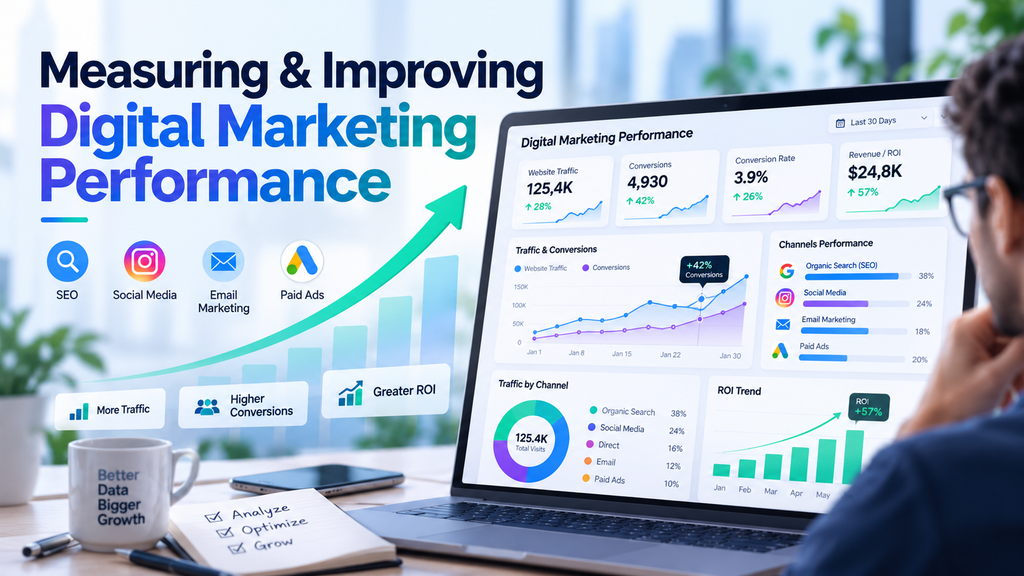
Create a Marketing Performance Dashboard
A dashboard can bring important marketing data into one clear view.
A useful dashboard may include:
- Total website traffic
- Organic traffic
- Leads
- Conversion rate
- Cost per lead
- Advertising spend
- CPA
- ROAS
- Revenue
- ROI
Because dashboards eliminate the need for marketers to examine each platform independently before comprehending overall findings, they facilitate the process of measuring digital marketing performance.
Common Digital Marketing Measurement Mistakes
Businesses sometimes collect large amounts of data without using it effectively.
Common mistakes include:
- Tracking too many metrics
- Focusing mainly on likes and impressions
- Ignoring conversion tracking
- Not setting clear goals
- Using inaccurate tracking
- Ignoring mobile performance
- Making decisions using too little data
- Not comparing performance over time
- Ignoring customer acquisition cost
- Failing to test new strategies
Avoiding these blunders increases the quality of Measuring Digital Marketing Performance.
Create a Continuous Optimization Process
Digital marketing performance should not be reviewed only when a campaign ends.
Successful businesses create a continuous cycle:
Measure → Analyse → Identify Problems → Test → Optimize → Measure Again
For example, if an advertisement generates a high number of clicks but few conversions, marketers can examine the landing page, audience targeting, offer, and message.
After making improvements, they can compare the new results with previous performance.
This ongoing procedure is the foundation of Measuring Digital Marketing Performance.
Conclusion
Digital marketing becomes more effective when businesses understand exactly what is working and what needs improvement.
Businesses may link their marketing efforts to significant results like traffic, leads, customers, sales, and revenue by using Measuring Digital Marketing Performance.
The process should begin with clear goals and relevant KPIs. Businesses can then use analytics platforms, conversion tracking, dashboards, and regular reporting to evaluate their campaigns.
However, measurement is only the first step. Businesses should use their findings to improve SEO, advertising, content, audience targeting, landing pages, and customer experiences.
Continuous testing and optimization allow marketing strategies to become stronger over time.
Ultimately, Measuring & Improving Digital Marketing Performance is not a one-time activity. It is an ongoing process of collecting data, understanding customer behaviour, testing improvements, and making smarter marketing decisions that support sustainable business growth.