
Table of Contents
Introduction
Getting a website to rank higher on Google involves much more than adding keywords, optimizing headings, or improving page speed. What happens outside your website also plays an important role in building online visibility and credibility. Off-Page SEO: How Backlinks Help Improve Website Rankings is crucial in this situation.
Activities carried out outside of your website to improve its authority, reputation, and search engine visibility are referred to as off-page SEO.Among all off-page SEO techniques, backlinks are one of the most discussed.
When a website links to one of your pages, it creates a backlink. Search engines can find information, comprehend connections between websites, and assess the value and applicability of pages with the aid of high-quality backlinks.
However, successful backlink development is not only about obtaining hundreds of links.Quality, relevance, context, and trust matter much more.
This guide to Off-Page SEO: How Backlinks Help Improve Website Rankings explains how backlinks work, why they matter, what makes a backlink valuable, and how businesses can build them using sustainable SEO strategies.
What Is Off-Page SEO?
Optimisation efforts that occur outside of your own website are referred to be “Off-page SEO.”
On-page SEO focuses on factors you can directly manage, such as text, headings, internal links, keywords, photos, and meta descriptions. Off-page SEO focuses on building your website’s reputation across the wider internet.
Common off-page SEO activities include:
- Backlink building
- Digital PR
- Brand mentions
- Guest posting
- Business directory listings
- Online reviews
- Social media promotion
- Influencer outreach
- Community participation
Understanding Off-Page SEO: How Backlinks Help Improve Website Rankings helps businesses see SEO as more than simply optimizing individual web pages.
When other trustworthy websites mention or link to good information, they can improve exposure and assist strengthen the website’s online presence.
On-Page SEO vs Off-Page SEO
Both on-page and off-page SEO contribute to a complete search engine optimization strategy.
| On-Page SEO | Off-Page SEO |
| Keyword optimization | Backlink building |
| Meta titles and descriptions | Brand mentions |
| Internal linking | Digital PR |
| Content optimization | Guest posting |
| Image optimization | Online reviews |
| Website structure | Business citations |
| Page experience | External promotion |
On-page SEO helps search engines comprehend your own pages, and off-page SEO promotes external credibility and exposure.
For strong long-term results, businesses should work on both.
What Are Backlinks?
Backlinks are links from other websites that point to yours.
For example:
Website A → Your Website
Suppose you publish an informative article about digital marketing. Your content is cited as a resource by another marketing website that finds it helpful. Your website receives a backlink from that external link.
Backlinks can provide several benefits beyond rankings. They can send visitors directly to your website, introduce your brand to new audiences, and help search engines discover new pages.
For this reason, Off-Page SEO: How Backlinks Help Improve Website Rankings is still a crucial subject in digital marketing.
However, not all backlinks have the same value.
A relevant backlink from a recognised website within your business may be significantly more beneficial than several links from irrelevant or low-quality websites.
How Backlinks Help Improve Website Rankings
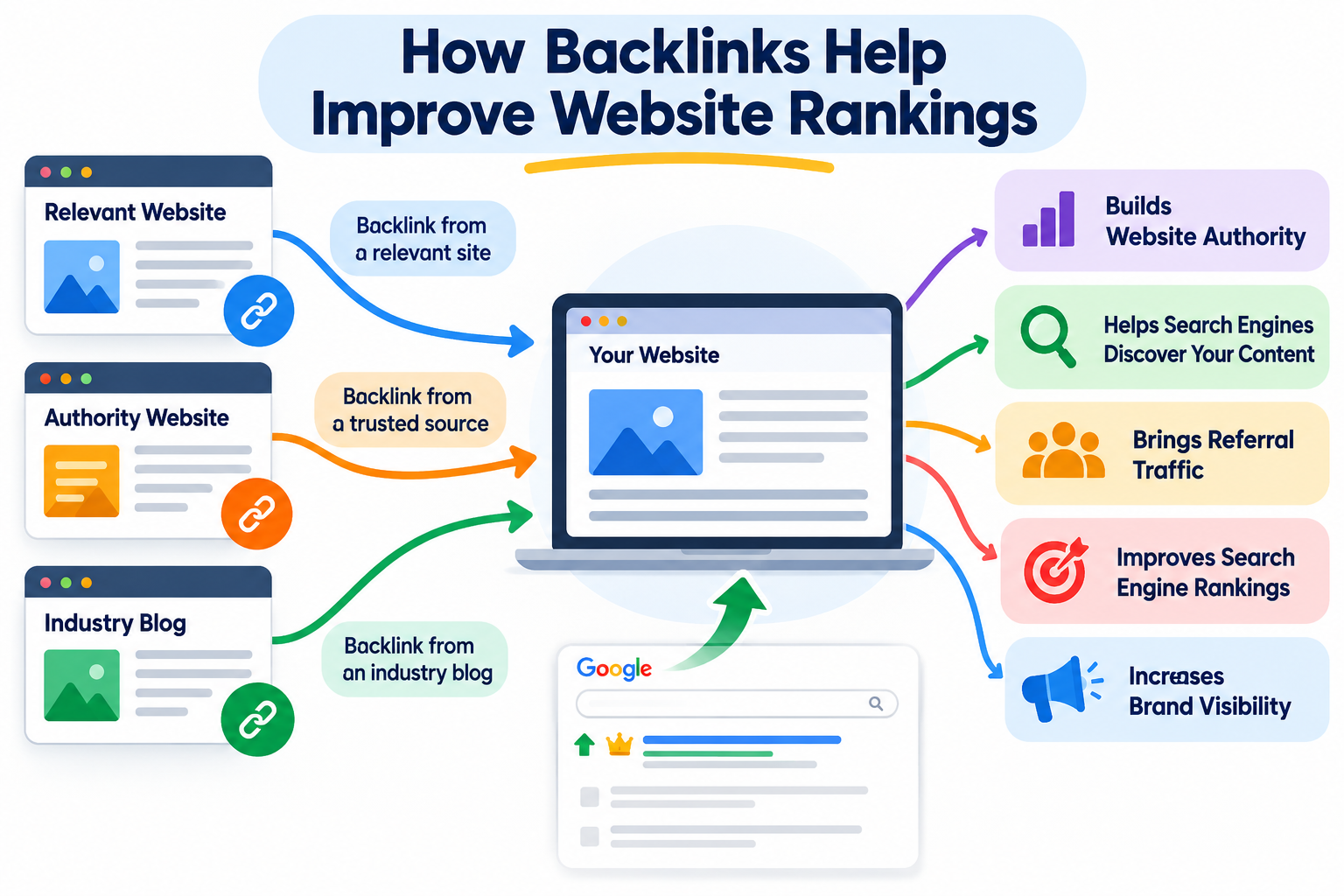
Backlinks can support SEO in several ways. Understanding these benefits makes Off-Page SEO: How Backlinks Help Improve Website Rankings easier for beginners to apply correctly.
1. Backlinks Can Build Website Authority
When trustworthy websites connect to valuable information, the links can help boost the website’s overall credibility.
Imagine two websites publishing similarly useful articles. One article has earned references from respected industry websites, while the other has little external recognition.
It’s possible that the first website’s content is supported by more powerful external signals.
This does not mean backlinks automatically guarantee a top ranking. Content quality, relevancy, usability, technical SEO, and search intent are just a few of the many variables that search engines take into account.
2. Backlinks Can Improve Content Discovery
Links are used by search engines to navigate between web pages.
When another website links to your page, search engine crawlers may follow the link and discover your content.
This can be especially useful for:
- Newly published articles
- New websites
- Product pages
- Service pages
- Research content
- Resource pages
Good internal linking and sitemap submission remain important, but external backlinks provide additional paths through which content can be discovered.
3. Backlinks Help Establish Relevance
Relevance is vital while discussing Off-Page SEO. How Backlinks Can Improve Website Rankings
Suppose you run a digital marketing website.
A backlink from an established SEO, marketing, business, or technology website has a clear contextual relationship with your content.
In contrast, an unrelated link placed randomly on a website with no connection to your industry may provide little meaningful context.
This is why relevant backlinks should normally be prioritized over simply increasing backlink numbers.
4. Backlinks Can Generate Referral Traffic
Backlinks are not useful only for search engines.
Real people can click them.
For example, if an industry publication recommends your guide and includes a link, interested readers may visit your website.
This is called referral traffic.
Referral visitors may:
- Read your content
- Explore your services
- Subscribe to your newsletter
- Contact your business
- Share your content
- Become potential customers
A great backlink can thus help with both SEO and marketing purposes.
5. Backlinks Can Increase Brand Visibility
Another important benefit of Off-Page SEO: How Backlinks Help Improve Website Rankings is increased exposure.
When your business appears on relevant blogs, industry websites, directories, publications, and resource pages, more people can discover your brand.
Over time, repeated exposure can strengthen brand recognition.
Even when users do not immediately click a link, seeing a company mentioned across trusted platforms can increase awareness.
What Makes a High-Quality Backlink?
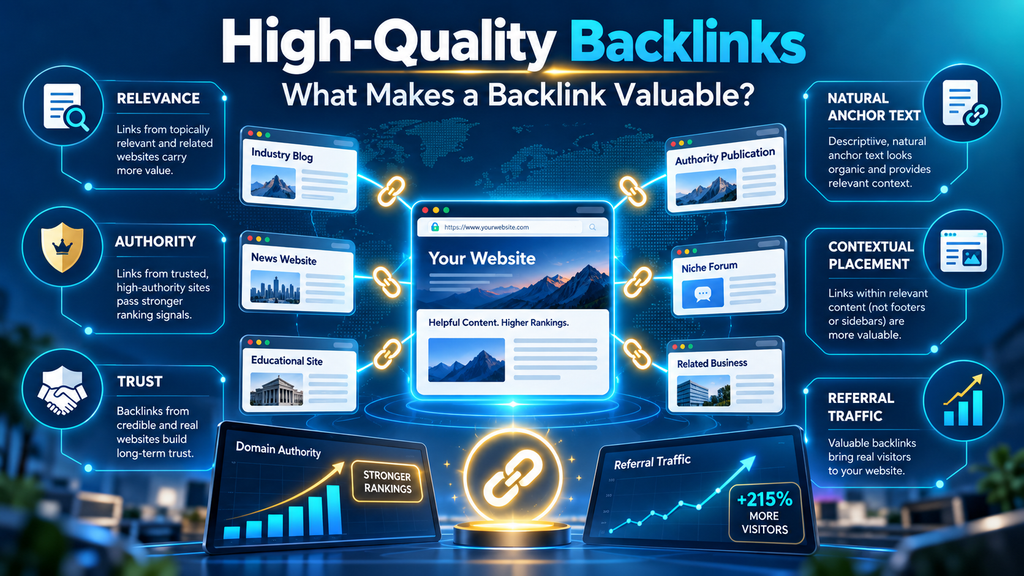
The quality of backlinks is more significant than just a website’s backlink count.
Several factors can help determine whether a backlink is valuable.
Relevance
The website and page linking to you should ideally be related to your industry or topic.
A digital marketing agency receiving a backlink from an SEO publication makes contextual sense.
Website Credibility
Links from established and trustworthy websites are generally more desirable than links from suspicious or spam-filled websites.
Contextual Placement
A backlink placed naturally inside useful content can provide clearer context than a random link placed in an unrelated section.
Natural Anchor Text
Anchor text is the clickable wording used for a link.
Examples include:
- Branded: ShrutiGrowth
- Exact match: off-page SEO
- Partial match: effective off-page SEO strategies
- Generic: learn more
- Naked URL: yourwebsite.com
Using different, natural anchor-text patterns helps maintain a healthier backlink profile.
Editorial Value
One of the best backlinks is a link included because the publisher genuinely believes your content helps its readers.
That type of link fits naturally into Off-Page SEO: How Backlinks Help Improve Website Rankings because it is based on content value rather than manipulation.
Types of Backlinks You Can Build
Businesses can earn backlinks through several approaches.
Editorial Backlinks
These occur when another website voluntarily references your article, research, guide, statistics, or resource.
They are often among the most valuable links because they are naturally earned.
Guest Posting Backlinks
Guest posting entails writing beneficial content for relevant third-party websites.
When appropriate, an author bio or contextual reference may link back to your website.
The main purpose should be providing genuine value to readers rather than producing large numbers of low-quality links.
Business Directory Links
Legitimate business and industry directories can help establish online presence.
Choose directories that are relevant, established, and useful to real users.
Resource Page Backlinks
Some websites maintain pages containing useful tools, articles, statistics, guides, or industry resources.
If your content genuinely adds value, you can contact the website owner and suggest your resource.
Digital PR Backlinks
Digital PR involves creating stories, research, surveys, expert commentary, or useful data that publications may want to cover.
This strategy can increase both backlinks and brand awareness.
Broken Link Building
Broken link building involves identifying links that no longer work and suggesting your relevant content as an alternative resource.
Best Ways to Build High-Quality Backlinks
A successful Off-Page SEO: How Backlinks Help Improve Website Rankings strategy should focus on earning links rather than producing them artificially.
Create Link-Worthy Content
Create resources people genuinely want to reference.
Examples include:
- Original studies
- Industry statistics
- Detailed tutorials
- Case studies
- Free templates
- Checklists
- Infographics
- Comparison guides
- Research reports
- Helpful tools
Strong content gives publishers a reason to link to your website.
Use Guest Posting Strategically
Look for reputable websites connected to your niche.
Instead of sending the same generic article to dozens of websites, create useful content specifically for their audience.
Build Industry Relationships
Networking can create natural opportunities for mentions, collaborations, expert contributions, and backlinks.
Build relationships with:
- Bloggers
- Journalists
- Business owners
- Industry experts
- Content creators
- Publishers
Promote Your Best Content
Publishing great content is only the beginning.
Promote it through:
- Email newsletters
- Relevant communities
- Social media
- Industry groups
More visibility can increase the chances of other publishers discovering and referencing your content.
Common Backlink Mistakes to Avoid
A poor link-building strategy can waste time and may create SEO problems.
Avoid practices such as:
- Buying large numbers of links purely for ranking manipulation
- Using automated backlink software
- Building backlinks from irrelevant websites
- Posting on spammy directories
- Excessive reciprocal linking
- Overusing exact-match anchor text
- Creating hundreds of low-quality profile links
- Focusing only on backlink quantity
The main lesson from Off-Page SEO: How Backlinks Help Improve Website Rankings is simple: quality should come before quantity.
Ten strong and relevant backlinks may provide more meaningful value than hundreds of questionable links.
How to Monitor Your Backlink Profile
Creating backlinks is just one step in the process.
You should also regularly monitor them.
Useful metrics include:
- Total backlinks
- Referring domains
- New backlinks
- Lost backlinks
- Anchor text
- Linking-page relevance
- Referral traffic
Popular backlink monitoring tools include:
- Google Search Console
- Semrush
- Ahrefs
- Majestic
Monitoring helps you understand which content attracts links and which backlink strategies are generating useful results.
Off-Page SEO Goes Beyond Backlinks
Although Off-Page SEO: How Backlinks Help Improve Website Rankings focuses heavily on backlinks, off-page optimization includes several other activities.
These can include:
- Social media visibility
- Online reviews
- Local citations
- Brand mentions
- Influencer collaborations
- Digital PR
- Forum and community participation
- Podcast appearances
- Industry partnerships
A strong digital presence is built when people discover, mention, recommend, and interact with your brand across different platforms.
Backlinks should therefore be treated as one part of a broader authority-building strategy.
Quick Off-Page SEO Checklist
Before starting your next campaign, use this checklist:
- Create genuinely useful content
- Target relevant websites
- Prioritize quality over quantity
- Earn contextual backlinks
- Keep anchor text natural
- Build relationships with industry publishers
- Use guest posting carefully
- Explore digital PR opportunities
- Monitor new and lost backlinks
- Track referral traffic
- Avoid spammy link-building techniques
- Combine backlinks with broader brand-building activities
Following these practices can make Off-Page SEO: How Backlinks Help Improve Website Rankings a sustainable part of your overall SEO strategy.
Conclusion
Off-Page SEO: How Backlinks Help Improve Website Rankings is an essential concept for businesses that want to strengthen their website’s authority, visibility, and online reputation.
Backlinks can help search engines discover pages, provide relevant external signals, generate referral traffic, and expose a brand to new audiences. However, backlink success should never be measured only by quantity.
Focus on links from trustworthy and relevant websites. Create original resources people naturally want to reference, build genuine industry relationships, use guest posting carefully, and explore strategies such as digital PR and broken link building.
At the same time, avoid spammy directories, automated link schemes, excessive exchanges, and unnatural anchor-text patterns.
Ultimately, effective off-page SEO is about earning trust across the web. When valuable content, strong relationships, brand visibility, and high-quality backlinks work together, they can support sustainable improvements in your website’s overall search performance.

Pingback: On-Page SEO for Beginners