
Table of Contents
Introduction
Social media has altered how companies interact with their clientele.. Platforms such as Facebook, Instagram, LinkedIn, YouTube, TikTok, and X allow brands to connect with people, promote products, answer questions, and build long-term relationships.
However, simply creating a social media account is not enough. Businesses need a clear strategy to decide what to post, when to post, how to communicate with followers, and how to measure results. This is where social media management in digital marketing becomes important.
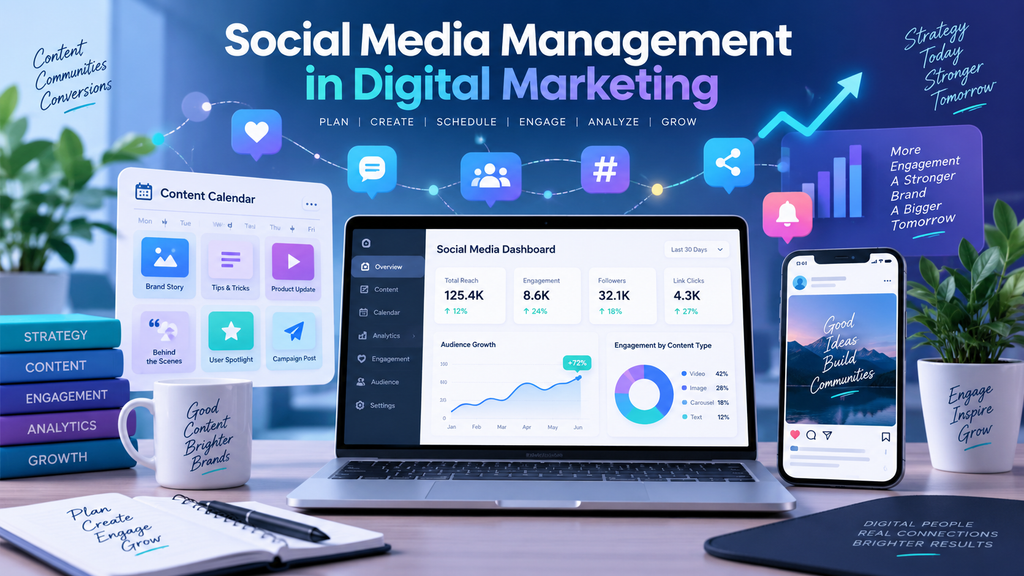
Social media management in digital marketing is the process of planning, creating, publishing, monitoring, and analyzing content across different social media platforms. It supports firms’ overall marketing objectives while assisting them in maintaining a consistent web presence.
When used effectively, social media management in digital marketing can increase brand awareness, improve customer engagement, generate website traffic, and support lead generation.
In this guide, we will understand what social media management is, how it works, its major components, benefits, tools, metrics, and best practices.
What Is Social Media Management in Digital Marketing?
Social media management in digital marketing refers to managing a brand’s complete presence across social media platforms.
It includes much more than uploading pictures or videos. A social media manager needs to understand the audience, create useful content, schedule posts, reply to followers, monitor conversations, and analyze performance.
The main activities involved in social media management include:
- Creating a social media strategy
- Planning content
- Creating images and videos
- Scheduling posts
- Responding to comments
- Managing direct messages
- Monitoring brand mentions
- Tracking social media performance
- Studying competitors
- Improving future campaigns
Effective social media management in digital marketing connects social media activities with larger business objectives such as increasing sales, building brand recognition, generating leads, or improving customer relationships.
Why Is Social Media Management Important?
Millions of people use social media platforms to discover businesses, learn about products, compare services, read reviews, and communicate with brands.
Because of this, businesses need to maintain an active and professional presence.
Builds Brand Awareness
One of the biggest benefits of social media management in digital marketing is increased brand visibility.
Regularly publishing useful and recognizable content helps people become familiar with a business.
Using consistent:
- Brand colors
- Fonts
- Logos
- Messaging
- Tone of voice
can make the brand easier to recognize.
Improves Audience Engagement
Social media enables businesses to communicate with consumers in both directions.
Instead of only displaying advertisements, businesses can talk directly with their audience.
They can:
- Reply to comments
- Answer questions
- Conduct polls
- Share Stories
- Respond to messages
- Ask for customer feedback
A devoted community can be built around a brand with strong involvement.
Drives Website Traffic
Another purpose of social media management in digital marketing is to direct users toward a company’s website.
Businesses can share blog posts, service pages, product pages, landing pages, and special offers through social platforms.
If the content attracts the right audience, these visitors may become leads or customers.
Key Components of Social Media Management
Successful social media management in digital marketing includes several connected activities.
1. Social Media Strategy
All social activities are guided by a social media strategy.
Before creating content, businesses should identify:
- Their target audience
- Marketing goals
- Suitable platforms
- Content topics
- Competitors
- Key performance indicators
For example, a B2B company may focus heavily on LinkedIn, while a fashion or lifestyle business may prioritize Instagram and TikTok.
The right strategy prevents businesses from posting random content without a clear purpose.
2. Content Creation
Content is one of the most important parts of social media management in digital marketing.
Businesses should create content that is useful, interesting, entertaining, or educational for their audience.
Popular social media content formats include:
- Images
- Carousels
- Short-form videos
- Reels
- Stories
- Infographics
- Blog promotions
- Customer testimonials
- Behind-the-scenes content
- Tutorials
- Polls and questions
Instead of constantly promoting products, brands should provide value to their followers.
3. Content Scheduling and Publishing
Consistency is essential for social media growth.
Businesses can plan posts ahead of time by using a content calendar.
A simple content calendar may include:
| Day | Content Type | Main Goal |
| Monday | Educational post | Awareness |
| Tuesday | Product or service post | Promotion |
| Wednesday | Reel or short video | Engagement |
| Thursday | Blog or useful tip | Website traffic |
| Friday | Customer testimonial | Trust |
| Saturday | Behind-the-scenes post | Engagement |
| Sunday | Poll or question | Community building |
Scheduling content can make social media management in digital marketing more organized and efficient.
Community Management and Customer Engagement
Social media is more than just publishing material.
Businesses also need to communicate with their followers.
Community management includes monitoring and responding to:
- Comments
- Questions
- Direct messages
- Product inquiries
- Complaints
- Brand mentions
- Customer feedback
Good community management makes customers feel that a real business is listening to them.
This is why engagement is an essential part of social media management in digital marketing.
Fast, professional, and helpful responses can also improve customer satisfaction.
Social Listening and Monitoring
Social listening involves monitoring online conversations related to a company, product, competitor, or industry.
Businesses can monitor:
- Brand mentions
- Product names
- Industry keywords
- Competitor names
- Customer discussions
- Emerging trends
Social listening helps companies understand what customers are saying about them.
For example, if several customers are discussing the same problem, the company can identify the issue and improve its product or service.
Therefore, listening and monitoring make social media management in digital marketing more customer-focused and data-driven.
How Does Social Media Management Work?
Businesses can follow a simple step-by-step process.
Step 1: Set Clear Goals
Every strategy should begin with a goal.
Common social media goals include:
- Increasing brand awareness
- Growing followers
- Generating leads
- Increasing sales
- Driving website traffic
- Improving customer service
- Increasing engagement
Clear goals make performance easier to measure.
Step 2: Identify the Target Audience
Understanding the audience helps businesses create relevant content.
Consider factors such as:
- Age
- Location
- Interests
- Profession
- Challenges
- Online behavior
- Preferred platforms
Knowing what the audience truly wants to see is the first step toward effective social media management in digital marketing.
Step 3: Select the Right Platforms
It is not necessary for a business to be equally active on all social media platforms.
It should choose platforms where its target audience spends the most time.
For example:
Instagram: Visual brands, fashion, beauty, lifestyle and creators.
LinkedIn: B2B companies, professionals and business services.
Facebook: Communities, local businesses and a broad customer base.
YouTube: Tutorials, educational videos and long-form video content.
TikTok: Short videos, entertainment and younger audiences.
Create a Social Media Content Strategy
A content strategy defines what type of information a brand will publish.
A balanced strategy may contain:
- Educational content
- Informational content
- Promotional content
- Entertainment
- Customer stories
- User-generated content
- Behind-the-scenes posts
- Industry updates
A good rule is to avoid making every post promotional.
Successful social media management in digital marketing focuses on creating value first and promoting products naturally.
Social Media Management vs Social Media Marketing
Although the terms are often used together, they are slightly different.
| Social Media Management | Social Media Marketing |
| Manages everyday social activities | Focuses on marketing campaigns |
| Creates and schedules content | Promotes products and services |
| Responds to followers | Generates leads and sales |
| Monitors conversations | Runs advertising campaigns |
| Tracks general performance | Measures campaign performance |
Social media management creates and maintains the brand’s online presence, while social media marketing focuses more directly on promotional goals.
However, both work together as part of a complete digital marketing strategy.
Popular Social Media Management Tools
Managing several platforms manually can become difficult.
Different tools can simplify social media management in digital marketing by helping businesses schedule posts, monitor engagement, and analyze results.
Popular tools include:
Sprout Social
Sprout Social provides features for publishing, engagement, analytics, reporting, and social listening.
Sprinklr
Sprinklr helps businesses manage social media communication, customer engagement, publishing, and analytics across multiple channels.
Brandwatch
Brandwatch is commonly used for social listening, consumer intelligence, analytics, and understanding online conversations.
Buffer
Buffer offers straightforward scheduling and publishing features.
Hootsuite
Hootsuite allows businesses to schedule content and manage multiple social profiles from one dashboard.
Meta Business Suite
Businesses using Facebook and Instagram can manage posts, messages, notifications, and basic analytics through Meta Business Suite.
Choosing the right tool depends on the size, budget, platforms, and marketing objectives of a business.
Important Social Media Metrics to Track
Data plays an important role in social media management in digital marketing.
Businesses should regularly monitor important metrics.
Reach
Reach tells you how many individual users saw your content.
Impressions
Impressions show how many times your content was displayed.
Engagement
Engagement includes:
- Likes
- Comments
- Shares
- Saves
- Replies
Engagement Rate
Engagement rate helps businesses understand how actively audiences interact with their content.
Follower Growth
Tracking follower growth helps measure how the audience is increasing over time.
Click-Through Rate
Click-through rate shows how many people clicked a link in a social media post or advertisement.
Conversion Rate
Conversion rate measures how many users completed a desired action, such as purchasing a product or submitting a form.
Monitoring these metrics helps businesses improve social media management in digital marketing instead of relying on assumptions.
Benefits of Social Media Management in Digital Marketing
Businesses can gain several benefits from a well-managed social media presence.
Key advantages include:
- Increased brand awareness
- Stronger customer relationships
- Better audience engagement
- Increased website traffic
- More lead-generation opportunities
- Better customer service
- Consistent brand communication
- Improved understanding of customers
- Better marketing decisions
- Easier performance measurement
Maintaining uniformity across many social media platforms is another benefit of professional social media management in digital marketing.
Common Challenges in Social Media Management
Social media management can also be challenging.
Businesses may experience problems such as:
- Creating fresh content regularly
- Managing multiple social platforms
- Responding quickly to customers
- Keeping up with changing trends
- Handling negative comments
- Understanding algorithms
- Measuring return on investment
- Maintaining brand consistency
Planning content in advance and using management tools can make these challenges easier to handle.
Best Practices for Effective Social Media Management
Businesses can improve social media management in digital marketing by following a few best practices.
Know Your Audience
Create content based on customer interests, questions, and problems.
Maintain Brand Consistency
Use a similar visual style and tone across platforms.
Focus on Quality
Posting frequently does not automatically generate better results.
Useful and relevant content is more valuable than posting just to remain active.
Respond to Followers
Engagement should be a two-way conversation.
Reply to comments and messages whenever appropriate.
Analyze Performance
Regularly check which posts receive the most:
- Reach
- Engagement
- Clicks
- Shares
- Conversions
Use this information to improve future content.
Experiment With Content
Try different formats such as:
- Reels
- Carousels
- Tutorials
- Infographics
- Stories
- Polls
- Live videos
Continuous testing makes social media management in digital marketing more effective over time.
Role of Artificial Intelligence in Social Media Management
Artificial intelligence is becoming increasingly useful for social media teams.
AI tools can assist with:
- Generating content ideas
- Creating captions
- Organizing content calendars
- Analyzing customer sentiment
- Identifying trends
- Automating repetitive tasks
- Creating reports
- Suggesting content improvements
However, businesses should still review AI-generated content to maintain accuracy, creativity, and a genuine brand voice.
Combining technology with human creativity can make social media management in digital marketing more efficient.
Future of Social Media Management in Digital Marketing
Social platforms continue to evolve, and businesses need to adapt their strategies.
Short-form videos, personalized content, creator partnerships, social commerce, artificial intelligence, and data-driven marketing are becoming increasingly important.
Customers also expect brands to respond quickly and communicate in a more authentic way.
As competition increases, effective social media management in digital marketing will require businesses to understand their audience, experiment with content, monitor performance, and adjust their strategies regularly.
Brands that focus on meaningful communication instead of only promotion are more likely to build stronger online communities.
Conclusion
Social media management in digital marketing plays an important role in building and maintaining a successful online presence. It includes planning content, creating posts, scheduling publications, engaging with customers, monitoring conversations, and analyzing performance.
An effective strategy helps businesses improve brand awareness, develop customer relationships, attract website visitors, and support marketing goals.
Successful social media management in digital marketing is not about posting as much content as possible. It is about publishing the right content for the right audience at the right time.
By setting clear goals, understanding the target audience, choosing suitable platforms, creating useful content, monitoring important metrics, and continuously improving the strategy, businesses can achieve better results from social media.
Ultimately, social media management in digital marketing connects brands with their audiences and helps turn everyday online interactions into meaningful business opportunities.