
Table of Contents
Introduction
The way people discover, compare, and purchase products has changed dramatically. Customers now search on Google, browse social media, read reviews, watch videos, and visit websites before making a buying decision. It is no longer sufficient for firms to just have an online presence.
A well-planned Digital Marketing Strategy helps a business reach the right audience, communicate the right message, and turn online attention into measurable results.
Instead of randomly posting on social media or running advertisements without a clear objective, businesses need a structured approach that connects their marketing activities with their overall goals.
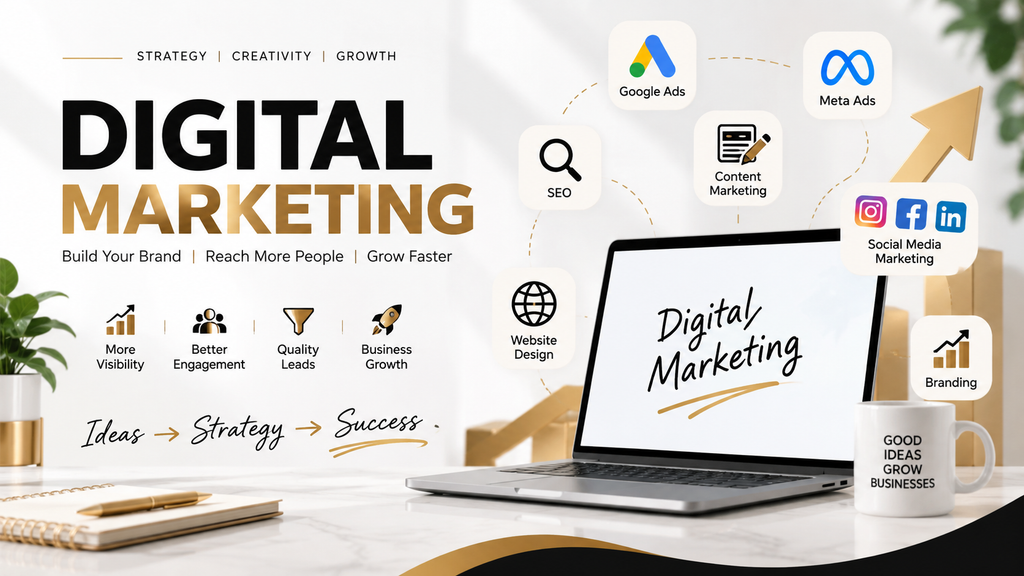
A strong Digital Marketing Strategy combines different channels such as SEO, content marketing, social media, email marketing, Google Ads, Meta Ads, and website optimization.
In this guide, you will learn what a digital marketing strategy is, why it matters, its most important components, and how to create an effective strategy step by step.
What Is a Digital Marketing Strategy?
An organised plan outlining how a company will use digital platforms and marketing channels to accomplish particular business objectives is called a Digital Marketing Strategy.
These goals may include:
- Increasing website traffic
- Generating qualified leads
- Improving brand awareness
- Increasing online sales
- Building customer relationships
- Improving customer retention
A strategy gives direction to your marketing efforts.
For example, if your goal is to generate more leads for a service business, your digital marketing strategy might include SEO to increase search visibility, educational blog content to attract potential customers, Google Ads to capture high-intent searches, and email marketing to nurture leads.
The exact combination depends on your audience, business goals, industry, and available resources.
Digital Marketing Strategy vs. Digital Marketing Plan
Although the two terms are often used together, they are not exactly the same.
| Digital Marketing Strategy | Digital Marketing Plan |
| Defines what you want to achieve | Defines how you will achieve it |
| Focuses on long-term direction | Focuses on specific actions |
| Identifies audiences and goals | Defines campaigns and schedules |
| Determines suitable channels | Specifies content and advertising activities |
| Answers “what and why?” | Answers “how and when?” |
Your strategy provides the overall direction, while your marketing plan turns that direction into specific tasks.
Why Is a Digital Marketing Strategy Important?
Businesses often make the mistake of using multiple marketing platforms without understanding how they work together.
A clear Digital Marketing Strategy ensures that every marketing activity has a purpose.
Provides Clear Direction
A strategy gives your marketing team clear goals.
Instead of simply trying to “increase social media followers,” you might set a more meaningful objective such as generating 100 qualified leads through social media within three months.
Helps Reach the Right Audience
Effective digital marketing is not about reaching everyone.
Reaching those who are most likely to become clients is the goal.
Understanding your target audience allows you to create relevant campaigns, advertisements, and content.
Improves Marketing ROI
A structured strategy helps businesses understand where their marketing budget should be spent.
Channels that generate strong results can receive more investment, while poorly performing campaigns can be adjusted or stopped.
Creates Consistent Branding
Customers may interact with your business through your website, Instagram, LinkedIn, Google, email, or advertisements.
A strong strategy ensures that your brand message remains consistent across these platforms.
Makes Performance Measurable
One of the key advantages of digital marketing is the ability to measure outcomes..
Businesses can monitor traffic, leads, conversions, advertising costs, engagement, and revenue.
Crucial Elements of an Effective Digital Marketing Plan
A successful Digital Marketing Strategy consists of several connected elements.
1. Clear Marketing Goals
Every strategy should begin with a clear goal.
Your aims should complement your company’s overarching ambitions.
Common goals include:
- Generate more leads
- Increase sales
- Improve website traffic
- Increase brand awareness
- Improve customer retention
- Enter a new market
Whenever possible, follow the SMART framework.
SMART goals are:
- Specific
- Measurable
- Achievable
- Relevant
- Time-bound
Instead of saying, “We want more website visitors,” a stronger goal would be:
“Grow the website’s organic traffic by 25% within a six-month period.”
2. Target Audience and Buyer Personas
Understanding your customers is essential.
A buyer persona represents your ideal customer based on research and customer information.
Consider factors such as:
- Age
- Location
- Occupation
- Interests
- Challenges
- Buying behavior
- Online activity
- Preferred social platforms
- Purchase motivation
For example, a startup founder looking for digital marketing services may be interested in generating leads quickly, building credibility, and keeping marketing costs under control.
Understanding these challenges allows you to create more relevant marketing messages.
3. Competitor Research
You can learn about your market from your competitors.
Analyze:
- Their website
- Search engine rankings
- Target keywords
- Social media presence
- Content strategy
- Advertising campaigns
- Offers
- Customer reviews
Copying competitors is not the goal of competitor study.
Instead, identify opportunities they may have missed and find ways to differentiate your brand.
How to Develop a Step-by-Step Digital Marketing Plan
Developing a successful Digital Marketing Strategy doesn’t have to be difficult..
Follow these steps to create a structured approach.
Step 1: Define Your Business Goals
Start by identifying what your business wants to achieve.
Your marketing objectives should directly support those goals.
For example:
Business Goal: Increase revenue.
Marketing Goal: Generate more qualified leads.
Digital Marketing Goal: Increase website conversion rate and generate leads through SEO and paid advertising.
This alignment ensures that your marketing activities contribute to real business outcomes.
Step 2: Understand Your Target Audience
Know who you want to reach before deciding on a marketing platform.
Ask questions such as:
- Who are our ideal customers?
- What problems are they trying to solve?
- Where do they search for information?
- Which platforms do they use?
- What influences their purchase decisions?
- What objections prevent them from buying?
Customer research can come from website analytics, surveys, sales conversations, social media insights, reviews, and customer feedback.
Step 3: Analyze Your Existing Digital Presence
Before creating new campaigns, review what you already have.
Audit your:
Website
Check:
- Loading speed
- Mobile responsiveness
- User experience
- Conversion opportunities
- Calls to action
SEO
Review:
- Organic rankings
- Keywords
- Backlinks
- Technical SEO
- Website content
Social Media
Analyze:
- Engagement
- Followers
- Content performance
- Leads generated
Paid Advertising
Review your Google Ads and Meta Ads campaigns.
Look at:
- Click-through rate
- Cost per click
- Cost per lead
- Conversion rate
- Return on advertising spend
This audit helps identify weaknesses and opportunities.
Step 4: Choose the Right Digital Marketing Channels
You don’t have to utilize every marketing channel out there.
Choose channels based on your audience and objectives.
| Digital Channel | Best Used For |
| SEO | Long-term organic traffic |
| Content Marketing | Education and authority |
| Social Media Marketing | Brand awareness and engagement |
| Google Ads | High-intent traffic and leads |
| Meta Ads | Awareness, leads, and sales |
| Email Marketing | Lead nurturing and retention |
| Website | Conversions and brand credibility |
For example, a B2B service business may focus heavily on SEO, Google Ads, LinkedIn, and email.
An ecommerce fashion brand might invest more in Instagram, Meta Ads, influencer marketing, and visual content.
SEO in Your Digital Marketing Strategy
An essential component of a long-term Digital Marketing Strategy is search engine optimisation.
When prospective clients look for pertinent goods, services, or information, SEO helps your website show up in search results.
An effective SEO strategy includes:
- Keyword research
- On-page SEO
- Technical SEO
- Quality content creation
- Internal linking
- Link building
- Local SEO
- Website speed optimization
For example, a digital marketing agency could target keywords related to SEO services, website development, social media marketing, Google Ads, and Meta Ads.
SEO may take time to produce results, but it can create sustainable traffic without paying for every website visit.
Content Marketing Strategy
Before they are ready to make a purchase, content helps draw in potential clients.
Helpful material may address consumer enquiries and position your company as a trustworthy information source.
Content formats include:
- Blog posts
- Videos
- Case studies
- Infographics
- Social media posts
- Guides
- Email newsletters
- Tutorials
A content strategy should answer three important questions:
- What does our audience want to know?
- Which keywords are they searching for?
- How can our content help solve their problems?
Publishing useful content consistently can improve SEO while building trust with potential customers.
Social Media Marketing Strategy
Social media gives brands the opportunity to connect with consumers and raise their profile.
However, posting without a plan usually produces inconsistent results.
Your social media strategy should define:
- Target audience
- Platforms
- Content themes
- Posting frequency
- Brand voice
- Engagement strategy
- Advertising approach
- Performance metrics
Concentrate on the platforms where your audience is most active rather than attempting to be everywhere.
Paid Advertising in Digital Marketing
Paid advertising can generate visibility and traffic much faster than many organic strategies.
Two popular options are Google Ads and Meta Ads.
Google Ads
Google Ads enables companies to connect with consumers who are actively looking for particular goods or services.
It is particularly valuable for high-intent keywords.
Meta Ads
Businesses can advertise on Facebook and Instagram with Meta Ads.
Campaigns can target users based on demographics, interests, behaviors, and previous interactions.
Paid campaigns should always be monitored and optimized to prevent unnecessary spending.
Creating a Digital Marketing Budget
Your marketing budget should be based on business goals rather than dividing money equally across all channels.
For example, an illustrative digital marketing budget could look like this:
| Marketing Activity | Example Budget Share |
| SEO | 25% |
| Paid Advertising | 30% |
| Content Marketing | 20% |
| Social Media | 15% |
| Email & Marketing Tools | 10% |
These percentages are only an example. The right allocation depends on the business, audience, objectives, and campaign performance.
Regularly review which channels deliver the best results and adjust your budget accordingly.
How to Measure Digital Marketing Strategy Performance
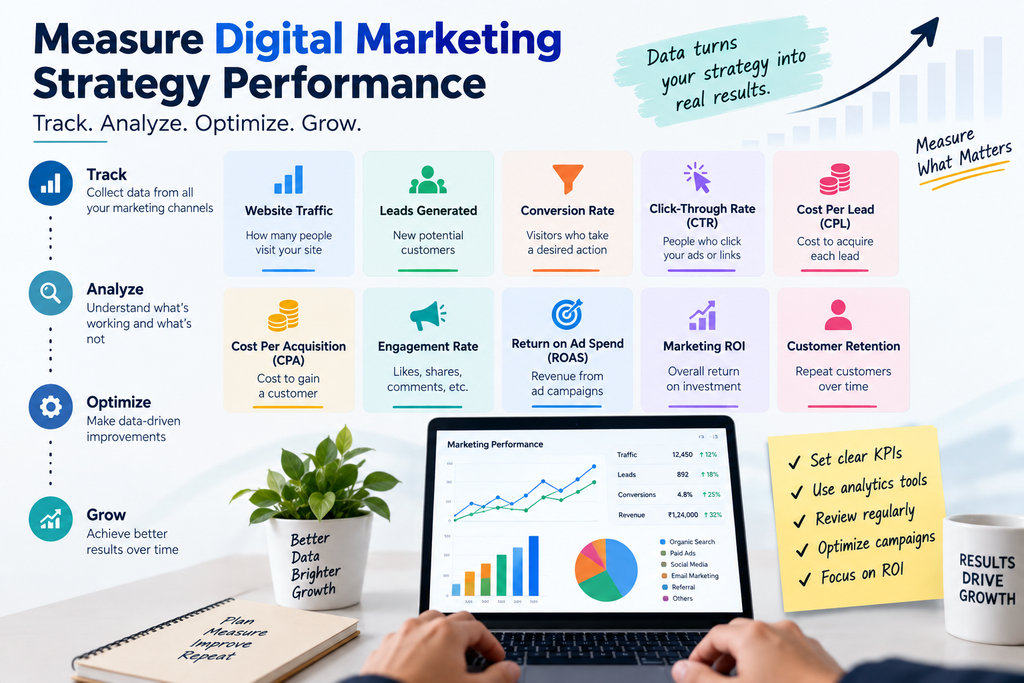
Measurement is essential because even a carefully designed Digital Marketing Strategy needs regular optimization.
Important KPIs include:
Website Traffic
Shows how many people visit your website.
Organic Traffic
Measures visitors coming from unpaid search engine results.
Conversion Rate
Shows the percentage of visitors who complete a desired action.
Cost Per Lead
calculates the amount of money needed to produce one lead..
Click-Through Rate
Shows the percentage of users who click an advertisement or link after seeing it.
Customer Acquisition Cost
calculates the overall cost of acquiring a new client.
Return on Ad Spend
Helps evaluate the revenue generated compared with advertising spend.
Marketing ROI
Shows whether your overall marketing investment is generating profitable results.
Monitoring these metrics helps businesses make decisions based on data rather than assumptions.
Common Digital Marketing Strategy Mistakes to Avoid
Even a good strategy can fail when businesses make common mistakes.
Avoid:
- Marketing without clear goals
- Trying to target everyone
- Ignoring customer research
- Using too many platforms at once
- Publishing low-quality content
- Ignoring SEO
- Running advertisements without conversion tracking
- Focusing only on website traffic
- Ignoring mobile users
- Failing to analyze campaign performance
- Copying competitors
- Expecting immediate results
Digital marketing requires continuous testing and improvement.
Simple Digital Marketing Strategy Framework
A practical strategy can be summarized in the following process:
Business Goals → Target Audience → Market Research → Marketing Channels → Content → Campaign Execution → Measurement → Optimization
The process does not stop after launching a campaign.
The final stage leads back into planning because customer behavior, competition, technology, and marketing platforms continue to change.
Businesses should therefore review their strategy regularly and make improvements based on actual performance data.
Frequently Asked Questions
What is a Digital Marketing Strategy?
A Digital Marketing Strategy is a structured plan for using online channels such as SEO, social media, email, content marketing, websites, and paid advertising to achieve specific business objectives.
Why is Digital Marketing Strategy important?
It helps businesses define clear goals, understand their target audience, select suitable marketing channels, manage budgets effectively, and measure campaign performance.
What are the main digital marketing channels?
Major digital marketing channels include SEO, content marketing, social media marketing, email marketing, Google Ads, Meta Ads, video marketing, and websites.
How frequently should a strategy for digital marketing be reviewed?
Businesses should monitor performance continuously and conduct more detailed strategy reviews periodically. The appropriate frequency depends on campaign length, market conditions, business goals, and available data.
Can small businesses use digital marketing strategies?
Yes. Small businesses can create effective digital strategies by focusing on a few high-impact channels instead of trying to compete everywhere at once.
Conclusion
A successful Digital Marketing Strategy gives businesses a clear direction for attracting, engaging, and converting customers online.
It begins with understanding your goals and audience. From there, businesses can select suitable digital channels, create valuable content, optimize their website, invest in paid advertising where appropriate, and measure performance using relevant KPIs.
The most effective strategy is not necessarily the one that uses the most platforms. It is the one that connects the right audience with the right message through the right channels.
Digital marketing also requires continuous improvement. By regularly reviewing campaign data, customer behavior, and market changes, businesses can refine their approach and make better marketing decisions.
A well-planned Digital Marketing Strategy ultimately turns separate marketing activities into a coordinated system designed to support sustainable business growth.

Pingback: SEO and How It Operates: A Comprehensive Guide for Novices