
Introduction
Have you ever searched for something on Google and wondered why some websites appear at the top while others are difficult to find? Search engine optimization is frequently the key to the solution. Businesses, bloggers, and website owners may increase their online visibility and draw in customers who are already looking for their goods, services, or information by understanding SEO and how it operates.
Search Engine Optimisation is referred to as SEO.It is the act of improving a website so that users can find relevant pages through organic search results and search engines may comprehend its content.
You don’t have to become a technical specialist to learn SEO and how it operates. The basic concept is straightforward: provide valuable content, make your website simple to navigate and comprehend, and show that your pages are pertinent to the queries you wish to appear for.
The primary forms of SEO, how search engines find and rank pages, and the actions you can take to improve your website.
What Is SEO?
A digital marketing technique called SEO, or search engine optimization, is used to increase a website’s visibility in search engine results.
When people search for a question, product, service, or topic, search engines try to provide the most useful and relevant results. SEO helps make your pages easier for search engines to discover, understand, and potentially display for those searches.
It’s critical to comprehend SEO and how it operates since organic search can drive traffic to your website without requiring you to pay for each click.
For example, imagine you own a digital marketing business. If someone searches for “SEO services for small businesses,” an optimized service page may have a better opportunity to appear in relevant search results.
SEO commonly focuses on:
- Relevant and useful website content
- Keyword research
- On-page optimization
- Website structure
- Technical performance
- Internal linking
- Backlinks
- User experience
- Search intent
SEO is not about inserting keywords everywhere. Making material both comprehensible to search engines and helpful to users is the main goal of effective SEO.
Search Engine Optimisation and How It Operates with Search Engines
You must first comprehend how search engines find and analyse web pages in order to fully comprehend SEO and how it operates
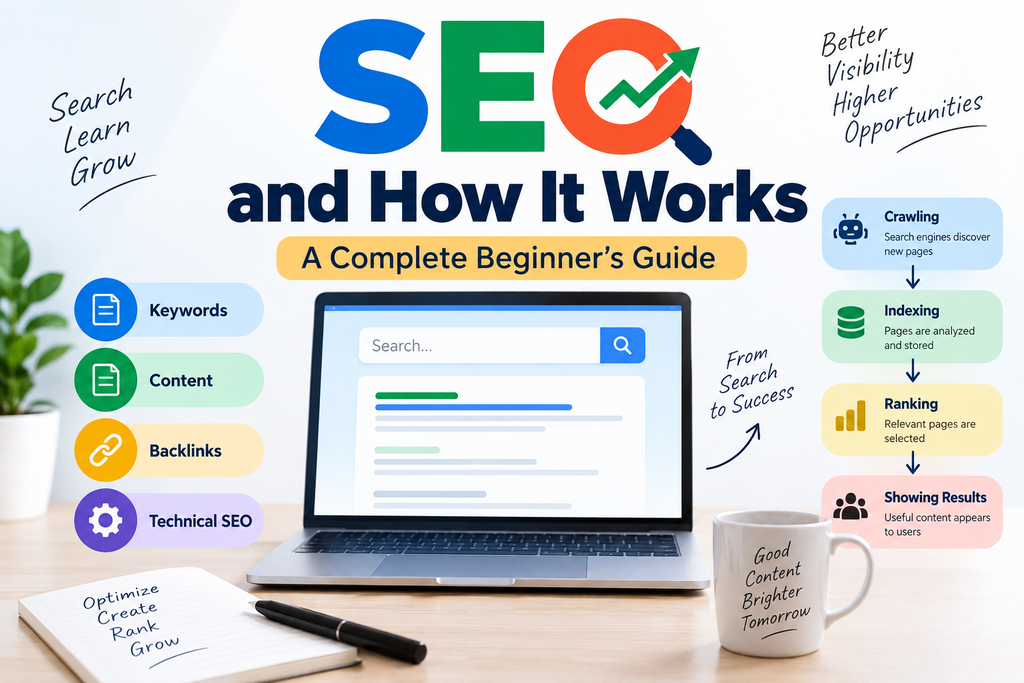
Google explains its search process in three main stages: crawling, indexing, and serving search results.
1. Crawling
The process of finding pages on the internet is called crawling.
Because it aids search engines in finding fresh and updated webpages, crawling is a crucial component of SEO and how it operates
Automated programs known as crawlers, bots, or spiders are used by search engines. These programs find new or updated pages by following links.
For example, if another page links to your new blog article, a crawler may follow that link and discover your content.
Additionally, a sitemap can tell search engines about key pages on your website. Google notes that crawlers discover URLs through links, sitemaps, and other previously known pages.
2. Indexing
After crawling a page, a search engine tries to understand its content.
By enabling search engines to process and arrange webpage data, indexing also aids in the explanation of SEO and how it operates
During indexing, information such as text, titles, images, and other page elements may be analyzed. Information about qualified pages can subsequently be stored by the search engine in its index.
Consider the index as a vast electronic library.
If your page cannot be properly accessed or understood, it may have difficulty appearing in search results.
3. Serving Search Results
The search engine looks through its index to locate pages that may be the most relevant when a user enters a search query.
Because search engines attempt to match relevant pages with the user’s search, serving relevant results is another essential component of SEO and how it operates
To evaluate which results are pertinent and helpful, it takes into account a variety of signals.
This is why understanding SEO and how it operates involves more than choosing keywords. Your content, website structure, usefulness, accessibility, and relevance all contribute to search visibility.
Simple SEO Process Chart
| SEO Stage | What Happens | What You Can Improve |
| Crawling | Search engines discover your pages | Internal links, sitemap, crawl access |
| Indexing | Search engines process and understand content | Clear content, titles, page structure |
| Search Query | A user searches for information | Relevant keywords and search intent |
| Ranking & Serving | Relevant pages may appear in results | Quality, relevance, usability and authority |
| User Visit | People click and interact with the website | Helpful content and good user experience |
SEO Process:
Crawling → Indexing → Content Understanding → Search Intent Matching → Search Results → Website Visitors
Why Is SEO Important?
Once you understand SEO and how it operates, it becomes easier to see why businesses invest in it.
People use search engines every day to find information, compare services, research products, and solve problems.
With SEO, your website can reach those people at the right moment.
Businesses may increase their visibility and establish connections with consumers looking for pertinent information, goods, or services by comprehending SEO and how it operates.
Important benefits of SEO include:
- Increased organic visibility
- More relevant website visitors
- Greater brand awareness
- Better website structure
- Improved user experience
- Long-term traffic opportunities
- Increased visibility for products and services
- Better understanding of customer search behavior
SEO does not demand payment for each organic click, in contrast to advertising. However, SEO still requires time, content, technical work, and continuous improvement.
Main Types of SEO
Another important part of understanding SEO and how it operates is learning the different areas of optimization.
On-Page SEO
Improvements made directly on individual webpages are referred to as “on-page SEO.”
It aids readers and search engines in comprehending the goal of your material.
Important on-page SEO elements include:
- Page titles
- Headings
- Keywords
- Meta descriptions
- Internal links
- Image alt text
- URL structure
- Helpful content
- Content organization
For example, if your primary keyword is “digital marketing strategy,” you might naturally use it in the title, introduction, relevant headings, body text, URL, and meta description.
However, keyword stuffing should be avoided.
Off-Page SEO
Off-page SEO involves signals and activities outside your own website.
One well-known example is backlinks.
Additionally, off-page optimization clarifies SEO and how it operates outside of your own website’s content and structure.
A backlink is created when a website links to one of your pages. In addition to helping users find your material, relevant and reliable links may add to the signals search engines use to assess webpages.
Off-page SEO may include:
- Quality backlinks
- Brand mentions
- Digital PR
- Industry relationships
- Content promotion
- Guest contributions where appropriate
The goal should be earning genuine recognition rather than creating large numbers of artificial links.
Technical SEO
Making a website easy to use for both people and search engines is the aim of technical SEO.
Because search engines must properly access, comprehend, and process your website, technical optimization is a crucial component of SEO and how it operates
Websites should be safe, quick, accessible, and device-neutral, according to Google.
Technical SEO commonly includes:
- Mobile-friendly design
- Site speed
- HTTPS
- Crawlability
- Indexability
- XML sitemaps
- Logical site structure
- Canonical URLs
- Fixing broken links
- Proper redirects
Even great content may struggle if search engines cannot properly access or understand the website.
Local SEO
Businesses that cater to clients in certain areas can benefit from local SEO.
Another helpful illustration of SEO and how it Operates for companies looking to target clients in particular areas is local optimisation.
For example, a dentist, restaurant, salon, consultant, or local marketing agency may want to appear when someone searches for a nearby service.
Local SEO can involve location-focused pages, consistent business information, reviews, and an optimized business profile.
How Keywords Work in SEO
Another crucial component of SEO and how it operates is keywords.
Another helpful illustration of SEO and how it operates for companies looking to target clients in particular areas is local optimisation.
Keywords are terms and phrases that users type into search engines.
For example:
- What is SEO?
- SEO for beginners
- Digital marketing agency
- Website design services
- Best SEO tools
You may learn what your potential audience is looking for by conducting keyword research.
Different types of keywords include:
Short-tail keywords:
Broad phrases such as “SEO services.”
Long-tail keywords:
Terms that are more precise, like “affordable SEO services for small businesses.”
Informational keywords:
Used when someone wants to learn something.
Commercial keywords:
Used when someone is researching products or services before making a decision.
Transactional keywords:
Often indicate that someone is ready to take an action such as buying, booking, or signing up.
Instead of placing the same keyword repeatedly, use it naturally with related terms and useful explanations.
Search Intent and SEO
What a user hopes to accomplish with a search is described by search intent.
Because search engines attempt to display results that correspond with what users truly desire, search intent is a crucial component of SEO and how it operates.
Understanding search intent is essential when learning SEO and how it operates because a page should satisfy the reason behind the search, not simply contain the same words.
For example, someone searching “how does SEO work?” probably wants an educational guide.
A person who searches for “SEO agency near me” is probably trying to find a service provider.
The four common categories of search intent are:
- Informational – looking for information
- Navigational – searching for a specific page or website
- Commercial – comparing options before deciding
- Transactional – ready to complete an action
If the material on your page is relevant to the search intent, your audience will find it more useful.
How Content Helps SEO Work
The core of SEO and how it operates is content.
Content is essential for search engines to understand the goal of your webpage.
Helpful content is a central part of SEO and how it operates because it gives both users and search engines clear information about a webpage
Instead than producing material primarily intended to manipulate results, Google advises producing trustworthy, helpful, and people-first content.
Good SEO content should:
- Answer the main search question
- Provide useful information
- Use clear headings
- Include natural keywords
- Be easy to read
- Add original value
- Avoid unnecessary repetition
- Keep information accurate and updated
Making a page that is worthy of being helpful to the searcher should be your aim.
How Backlinks Support SEO
When other related websites link to your material, backlinks can help with exposure and discovery
Because they can aid search engines in finding information and comprehending the connections between websites, backlinks are another crucial component of SEO and how it operates
For example, if an industry website references one of your detailed guides, readers may visit your website through that link. Search crawlers can also discover pages by following links.
Focus on earning links through:
- Helpful blog content
- Original research
- Useful guides
- Industry partnerships
- Digital PR
- Shareable resources
- Expert contributions
Avoid paying for manipulative links simply to influence rankings.
How Long Does SEO Take to Work?
People learning SEO and how it operates often expect immediate results.
However, SEO usually takes time.
Google states that some website changes can be reflected within hours while others may take several months to show their full effect.
The timeline can depend on factors such as:
- Website age and condition
- Competition
- Content quality
- Technical problems
- Existing visibility
- Website authority
- Frequency of improvements
- Search demand
SEO should therefore be treated as an ongoing marketing process rather than a one-time task.
How to Start SEO for Your Website
If you are new to SEO and how it operates, start with the basics instead of trying to optimize everything at once.
Step 1: Understand Your Audience
Know who your ideal visitors are and what problems they are trying to solve.
Step 2: Conduct Keyword Research
Find keywords that match your products, services, and customer questions.
Step 3: Understand Search Intent
Decide whether users searching each keyword want information, a service, a product, or another type of result.
Step 4: Create Useful Content
Create pages that clearly answer the searcher’s needs.
Step 5: Optimize On-Page Elements
Improve:
- Page titles
- Headings
- URLs
- Meta descriptions
- Images
- Internal links
Step 6: Improve Technical SEO
Make sure your website is accessible, mobile-friendly, secure, and easy to navigate.
Step 7: Build Authority Naturally
Create valuable resources that people may want to reference and share.
Step 8: Track Performance
Measure results and continue improving.
How to Measure SEO Performance
Understanding SEO and how it operates also means measuring whether your strategy is producing useful results.
Important SEO metrics include:
- Organic traffic
- Search impressions
- Search clicks
- Click-through rate
- Keyword visibility
- Conversions
- Indexed pages
- Landing-page performance
Google Search Console can help website owners understand how their site performs in Google Search, while analytics tools can show how visitors interact with the website.
Do not focus on rankings alone. A page that attracts relevant visitors and generates enquiries or sales may be more valuable than a page receiving large amounts of unrelated traffic.

Common SEO Mistakes to Avoid
Beginners sometimes make SEO more complicated than necessary.
Avoid these common mistakes:
- Keyword stuffing
- Copying content from other websites
- Ignoring search intent
- Publishing thin or unhelpful content
- Using unclear page titles
- Ignoring mobile users
- Having a slow website
- Creating broken internal links
- Buying poor-quality backlinks
- Blocking important pages from crawling
- Ignoring indexing problems
- Never updating old content
Google also makes clear that following technical guidelines does not guarantee that a page will be crawled, indexed, or ranked. SEO improves your website’s ability to participate effectively in search, but there is no guaranteed number-one position.
Frequently Asked Questions About SEO and How It Works
What is SEO in simple words?
SEO is the process of improving a website so search engines can better understand its content and people can find it through organic search results.
How does SEO work?
SEO helps improve website content, relevance, technical accessibility, structure, and authority. Search engines crawl pages, process them for indexing, and may serve relevant pages when users search.
Is SEO free?
You do not pay a search engine for an organic click. However, SEO may require investment in content creation, tools, website improvements, developers, or SEO professionals.
Can beginners do SEO?
Yes. Beginners can start with keyword research, helpful content, page titles, headings, internal linking, image optimization, and basic technical checks.
Is SEO a one-time process?
No. Search behavior, competition, websites, and content change over time. SEO works best as an ongoing process of monitoring and improvement.
Conclusion
Understanding SEO and how it operates is an important first step toward building stronger online visibility.
SEO helps search engines discover and understand your website while helping users find useful content that matches their searches.
The process begins with crawling and indexing, but successful SEO also involves useful content, keyword research, search intent, on-page optimization, technical SEO, links, and a positive user experience.
Learning SEO and how it operates does not mean finding a secret formula for instant rankings. Instead, focus on creating a technically accessible website and genuinely helpful content for your audience.
Start with the basics, measure your results, fix problems, update your content, and continue improving. Over time, a consistent SEO strategy can help your website become easier to discover and more valuable to the people you want to reach.

Pingback: Digital Marketing Strategy : A Complete Guide For 2026